My parents introduced me to the persimmon when I was very young. We did not have it often, since they were very expensive and hard to find in Europe. I just remembered that I was very confused, because it looked like an orange tomato with some weird leaves that had to be yanked off, and my parents kept calling it an "orange tomato fruit."
Tomatoes were always regarded as vegetables in our household, so why was this a fruit? (Never mind the biologist's argument that tomatoes are fruit for now). So this "sweet vegetable" was a fruit, lacked the fluid, seedy chambers of a tomato, but had a similar skin and flesh texture.
I was re-introduced to this fruit again by a coworker in 2004. She was very generous to share these with me and I was instantly hooked on these "orange tomatoes." Her culture calls it the "Sharon Fruit" and my grandmother calls them shì zi (柿子).
There are two kinds of persimmons: astringent and non-astringent.
Astringent persimmons contain high levels of tannins, which is responsible for the dry, puckering aftertaste when consuming unripe fruit. Therefore, astringent persimmons should not be consumed until they are ripe and soft; they should feel like overripe apricots or peaches. The ripening process is what rids the high levesl of tannins. The most common persimmon is the Japanese persimmon, recognizable by its distinct heart-shape body. Trying to eat them before they are ripe gives off a chalky and displeasing aftertaste and texture in the mouth. I speak from experience ;)
Non-astrigent persimmon (my favorites!) are less fussy about when they are eaten, since they have low levels of tannis. I like them when they are still firm and waxy on the outside, since they are crispy like an apple on the outside, yet fleshy and not mush like pumpkin pulp. However, consuming them while they are over-ripe is also fine. The most common persimmon have no tip like its Japanese cousin; instead it is squat like a beef-steak tomato and often also have the label 'fuyu' when it is sold.
While perusing the grocery stalls in Hong Kong, I could not resist picking up one of these.


We enjoyed this persimmon chilled. And although my parents were hesitant about consuming this persimmon while "unripe," with some coaxing they enjoyed this new way, since the fruit tasted crisp, fresh and light, and was less messy. :)
Today persimmons can be easily found in any major grocery store during the winter months and almost year around at any Asian grocery store. If you have not tried them, you are in for a treat. Let me know what you think!

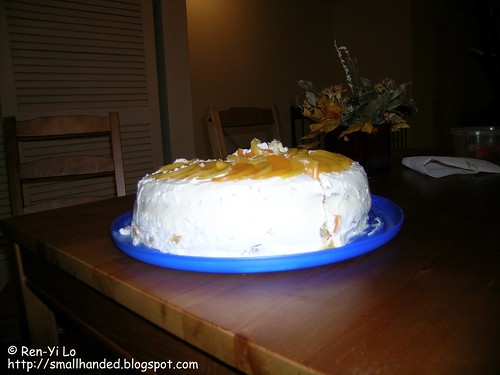
Amanda's Birthday was one of the summer birthdays and I wanted to create something light and fruity. Unfortunately I was also crunched for time, so I pulled out a recipe that someone from work recommended to me. It is a cake recipe based on a cake mix, which I am generally against. I am a control freak and like to know of all the ingredients that go into cakes. Additionally, I try to scale back on sugar whenever I can. However, this cake turned out to be moist, delicious and not to sweet. It was such a hit that I made it again for my brother's birthday later that fall. My family really enjoyed it, which says a lot, since they generally do not enjoy very sweet desserts. Also, one last sidenote: This is an easy, introductory cake for someone who wants to try their hand at baking.
Peaches & Cream Cake
adapted from Anne Byrn, "The Cake Mix Doctor"
Ingredients:
* vegetable shortening, for greasing cake pans
* flour, for dusting cake pans
* 1 can (29 oz) peach halves, drained and syrup reserved
* 1 pkg yellow cake mix
* 8 tbsp butter, melted
* 4 eggs
* 1 tsp pure vanilla extract
* Fresh Whipped Cream (recipe to follow)
Directions:
01. Preheat oven to 350 degrees F.
02. Grease two 9" cake pans with vegetable shortening; dust with flour; shake out excess flour.
03. Place 8 peach halves in a food processor fitted with steel blades; process until smooth.
04. Reserve 3/4 cup peach syrup and the rest of the peach halves.
05. Place cake mix & melted butter in a mixing bowl; mix on low speed, adding one egg at a time.
06. Add peach puree; add vanilla extract; mix on high for 2-3 minutes.
07. Divide batter into both cake pans evenly.
08. Bake for 28-32 minutes, or until toothpick inserted comes out dry.
09. Remove pans from oven; cool for 10 minutes.
10. Remove cakes from the pan; poke holes with toothpick into cake while warm.
11. Drizzle 1/4 cup of reserved syrup juices on each cake; let cool completely.
Fresh Whipped Cream
Ingredients:
* 1 cup heavy cream
* 1 pkg Dr. Oetke's Vanilla Sugar
* 1/4 cup peach syrup
Directions:
01. Whip heavy cream in chilled bowl & chilled beaters.
02. When soft peaks form, add Dr. Oetke's Vanilla Sugar.
03. Drizzle in peach syrup.
Assembly Directions:
01. Cut remaining peach halves into slices for decorating.
02. Place one cake right side up; spread with whipped cream.
03. Place second cake right side up on first; frost top & sides with remainder of whipped cream.
04. Assemble peach slices on top of the cake.
Tips & Tricks:
* Do not over beat the whipped cream.
* If you do not have Dr. Oetke's Vanilla Sugar at hand, substituting 1 tbsp confectioner's sugar & 1 tsp pure vanilla extract will yield just as tasty a whipped cream.
* Alternative to decorating the cake with peach slices, cubing the peaches and adding them to 1/3 the whipped cream to use as the center filling also works.